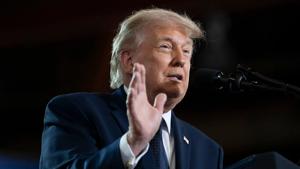
Trump defends tariffs in Michigan as new legal challenge advances
President Donald Trump defended his tariffs at length in Michigan on Monday, touting an auto-industry comeback as his latest legal authority for the duties faces a fresh court challenge.
Speaking at General Motors’ Milford Proving Ground, Trump credited his trade agenda with reviving American manufacturing. He touted a 25% tariff on foreign automobiles as something “no other president had the courage to ever do” and said companies that build in the U.S. “pay zero tariff,” casting the duties as a cost borne by foreign producers.
Economists say otherwise: the nonpartisan Tax Policy Center puts the average tariff burden at about $920 per U.S. household in 2026, and researchers at the Federal Reserve Bank of New York and Yale Budget Lab have found Americans bear most of the cost, a conclusion the White House disputes.
The president did not mention the lawsuit filed days earlier over his newest tariffs or the separate round of duties he imposed on Canada this month.
On July 24, spice importer Burlap & Barrel and watch retailer Collective Horology sued in the U.S. Court of International Trade, arguing the administration’s forced-labor tariffs exceed its authority under Section 301 of the Trade Act of 1974. That forced-labor rationale, the stated basis for the latest round, went unmentioned Monday. Trump has repeatedly shifted his reasoning and legal footing for the tariffs as his trade policy evolved during his second term.
The plaintiffs, represented by the Liberty Justice Center, say the government imposed near-uniform duties of 10% or 12.5% across about 60 economies without showing how each country’s conduct burdens U.S. commerce.
The forced-labor tariffs are the administration’s third attempt at broad import taxes. The Supreme Court struck down Trump’s tariffs under the International Emergency Economic Powers Act on Feb. 20. A trade court found his 10% Section 122 replacement unlawful in May. That tariff expired July 24 ahead of the new Section 301 round.
Canada, Michigan’s largest trading partner, faces separate tariffs. On July 20, Trump invoked Section 338 of the Tariff Act of 1930 for the first time, imposing 50% duties on about $20 billion in Canadian goods, effective Aug. 19.
The administration has not published an estimate of what its latest tariffs cost U.S. households or importers, or what share of imports they cover.






Mostly Sunny
Latest News Stories

Central Ohio data center will have its own power plant

Supreme Court allows Trump to fire FTC members

Welding Competition Draws 55 High School Students From 14 Schools to Lake Land

Supreme Court blocks Trump’s firing of Lisa Cook

America 250: Freedom Trucks travel across U.S. celebrating American history

U.S. Supreme Court allows late mail-in ballots to be counted

Illinois Quick Hits: Gas prices fall, remain higher than a year ago

White teacher gets new life for race discrimination suit

Poll: About half of Americans confident in democracy’s future

Pennsylvania will be at the ‘Great American State Fair’ after all

Everyday Economics: The consumer is still spending, but not out of the woods

Illinois lawmaker promotes welfare water aid bill as critics raise concerns over federal expansion